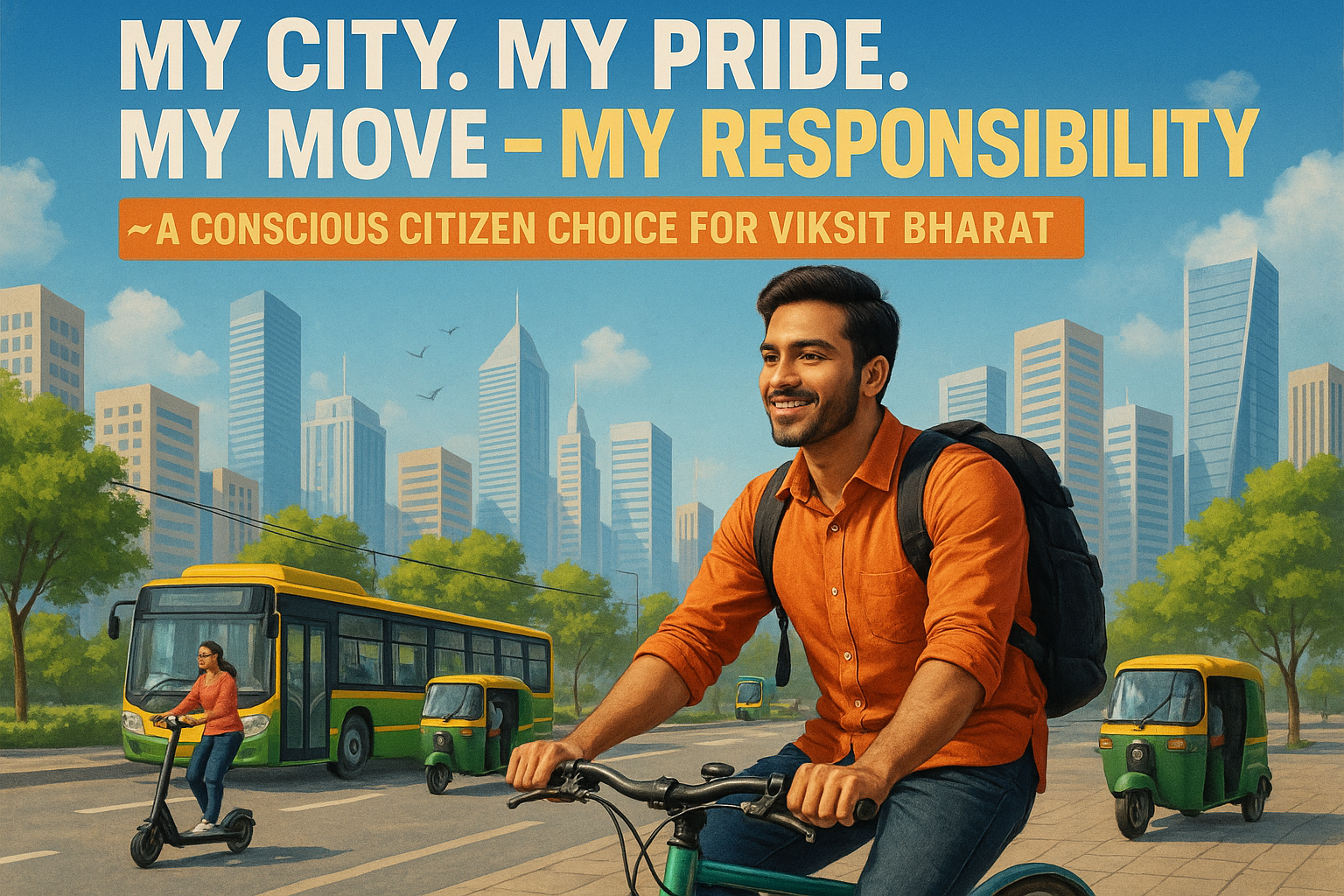
🚦 Introduction: Why Mobility Defines Happiness in Cities
Cities are not just collections of buildings — they are networks of movement. The ability to move freely and efficiently defines whether a city is liveable, productive, and joyful. In Gurugram, a city often seen as India’s “Millennium City,” mobility is both its strength and its biggest challenge.
On one hand, Gurugram boasts gleaming expressways, metro connectivity to Delhi, and a booming economy driven by corporate headquarters. On the other, residents experience daily traffic nightmares, unsafe roads for pedestrians and cyclists, and a heavy dependence on private vehicles.
Mobility here is not just about transport. It is about access — access to jobs, schools, healthcare, and leisure. Poor mobility directly translates to lost productivity, increased stress, pollution, and reduced quality of life.
If Gurugram truly wishes to become a model for Viksit Bharat 2047, it must rethink mobility as a citizen-first service rather than a car-centric convenience.
🚧 The Current Reality in Gurugram
🔴 Congestion Hot Spots
- NH-48 Expressway: Bottlenecks at IFFCO Chowk, Hero Honda Chowk, and Kherki Daula toll.
- CyberHub & Golf Course Road: Choked during peak office hours.
- Sohna Road: Narrow lanes, ongoing construction, and rising residential density.
📊 Key Statistics (2024–2025)
- Vehicle Ownership: Over 1.1 million registered vehicles in Gurugram.
- Daily Traffic: Nearly 1.8 million vehicles pass through NH-48 stretch daily.
- Commute Time: Average working professional spends 90–120 minutes daily in commute.
- Public Transport Share: Less than 25% of daily trips rely on metro, buses, or shared transport.
- Pollution Impact: Transportation contributes to nearly 40% of Gurugram’s PM2.5 levels.
🚶 Pedestrian & Cyclist Risks
- Gurugram ranks among NCR’s least walkable cities, with only 25% of roads having functional footpaths.
- Between 2019–2023, nearly 22% of road fatalities involved pedestrians or cyclists.
Mobility here is inefficient, unsafe, and inequitable. Citizens with cars manage (albeit with stress), while those without cars face limited options and unsafe conditions.
🌍 Global Best Practices Gurugram Can Learn From
- Amsterdam (Netherlands): The Bicycle Capital
- 48% of daily trips made by bicycles.
- Protected cycle lanes and integrated cycle parking at every metro/train station.
- Strong cultural messaging: “Cycling is freedom.”
- Singapore: Seamless Integration
- Smart cards connect buses, MRT (metro), taxis, and bike rentals.
- Peak pricing and electronic road pricing (ERP) reduce congestion.
- Walkability embedded in urban planning — shaded sidewalks, underpasses, and green connectors.
- Seoul (South Korea): Smart Bus Rapid Transit (BRT)
- Dedicated bus-only lanes reduced peak congestion by 30%.
- Real-time arrival info at bus shelters boosted reliability.
- Integration with metro ensures coverage across city zones.
- Bogotá (Colombia): TransMilenio Success
- One of the most efficient BRT systems globally.
- Affordable fares and frequent buses encourage public adoption.
- Strong citizen engagement in planning.
👉 Gurugram’s future must blend Amsterdam’s cycling culture, Singapore’s integration, and Seoul’s smart bus networks, adapted to Indian realities.
🏙️ Extended Case Studies from Gurugram
Case Study 1 — Rapid Metro Missteps
- Launched in 2013, designed to decongest Cyber City.
- Poor last-mile connectivity and high fares limited adoption.
- Handed over to Delhi Metro Rail Corporation (DMRC) in 2019.
Lesson: Transit fails when it doesn’t integrate seamlessly with buses, e-rickshaws, and cycling networks.
Case Study 2 — Shared Mobility Apps
- Between 2018–2020, Gurugram piloted bike-sharing startups like Yulu & Mobycy.
- Users welcomed them, but absence of cycle lanes and safe parking led to declining adoption.
Lesson: Infrastructure and policy support must accompany innovation.
Case Study 3 — Gurugram Cyclothon & Citizen Movements
- Events like Cyclothons and Car-Free Day raised awareness.
- Initial enthusiasm faded without institutional support or permanent cycling lanes.
Lesson: One-day events inspire; structural change sustains.
Case Study 4 — Corporate-Led Mobility (DLF CyberHub Shuttles)
- Corporates in Cyber City introduced private shuttle services connecting metro stations and office blocks.
- Popular among employees, but limited to a few companies.
Lesson: Private initiatives work, but need scaling with public-private partnerships.
🗣️ Citizen Voices
- “I spend 3 hours daily in traffic. That’s family time I’ll never get back.” — Neha, IT Professional, Sector 57
- “We want to cycle to work, but the roads don’t allow it. We fear for our lives.” — Rohit, Startup Founder, Cyber City
- “My elderly parents struggle to cross the road safely even for a morning walk.” — Meera, Resident, Palam Vihar
These voices reflect the urgency of rethinking mobility not as infrastructure, but as quality of life.
📈 The Opportunity: Smart, Green Mobility
🔹 Integrated Transit Hubs
- Seamless connections between metro, bus terminals, and last-mile e-rickshaws.
- Smart ticketing system linking all modes.
🔹 Green Commutes
- Cycling superhighways connecting Cyber City, Golf Course Road, and Sohna Road.
- Pedestrian-friendly zones in markets like Galleria, Sector 29, and MG Road.
- Tree-lined shaded sidewalks for safe, heat-resistant walking.
🔹 Smart Traffic Management
- AI-driven adaptive traffic signals (already piloted at IFFCO Chowk).
- Congestion pricing on peak-hour routes like NH-48.
- Real-time commuter dashboards for public awareness.
🔹 Corporate Role in Mobility
- Employer-sponsored office buses with live tracking.
- Flexible work timings and hybrid models to reduce rush hour spikes.
- Parking incentives for carpooling employees.
🛠️ Citizen Toolkit
For Residents
✅ Join RWAs to demand safe pedestrian crossings, zebra stripes, and cycle lanes.
✅ Use ride-sharing & carpool apps to reduce car dependency.
✅ Support pilot projects like e-bike rentals and shuttle buses.
✅ Volunteer in “Mobility Audits” — documenting unsafe spots and suggesting fixes.
For Corporates
✅ Sponsor shared shuttles connecting major office clusters with metro hubs.
✅ Provide employees with incentives for carpooling.
✅ Create “Mobility Champions” groups in offices to encourage behavioral change.
For Policymakers
✅ Expand metro reach to Old Gurugram, Manesar, and Dwarka Expressway.
✅ Build dedicated bus lanes & enforce priority rules.
✅ Integrate bike-share & e-rickshaws into official urban mobility plan.
✅ Mandate Green Mobility Plans for all large developers.
🌟 Global Best Practices Adapted for Gurugram
- Car-Free Zones (Copenhagen, Denmark)
- Introduce pilot pedestrian-only streets in Sector 29 & Galleria Market.
- School Mobility Plans (Barcelona, Spain)
- Encourage safe walk-to-school programs for Gurugram’s 1,000+ schools.
- Public Bike Sharing (Paris, France)
- Relaunch bike-share with better infrastructure, parking hubs, and smart cards.
- Workplace Mobility Credits (London, UK)
- Companies offer mobility allowances redeemable on public transport, cycling, or shared rides.
✨ Closing Thought
Mobility is not just about getting from Point A to Point B. It is about freedom, dignity, and time — the most precious commodity of all. If Gurugram can reimagine its transport network as citizen-first, it will reduce stress, unlock productivity, and create a truly happier, healthier, and smarter city.
By 2047, Gurugram can be India’s model for sustainable urban mobility, inspiring cities across Bharat to put people, not cars, at the heart of development.
My City. My Pride | My Move – My Responsibility